Full assessments or Micro Assessments
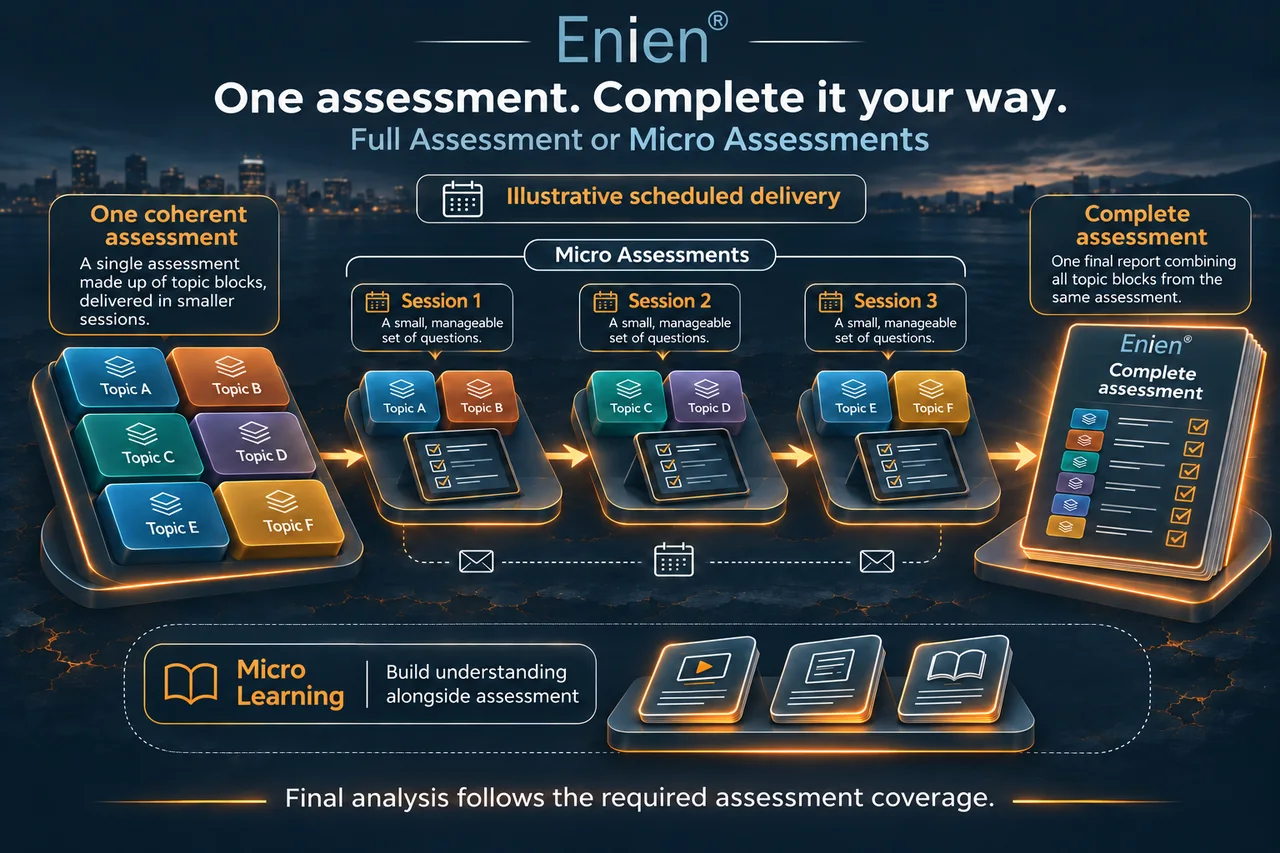
Complete the topic in one go, or answer coherent groups of questions a topic at a time. Both routes complete the same underlying assessment.
Understand. Learn. Improve.
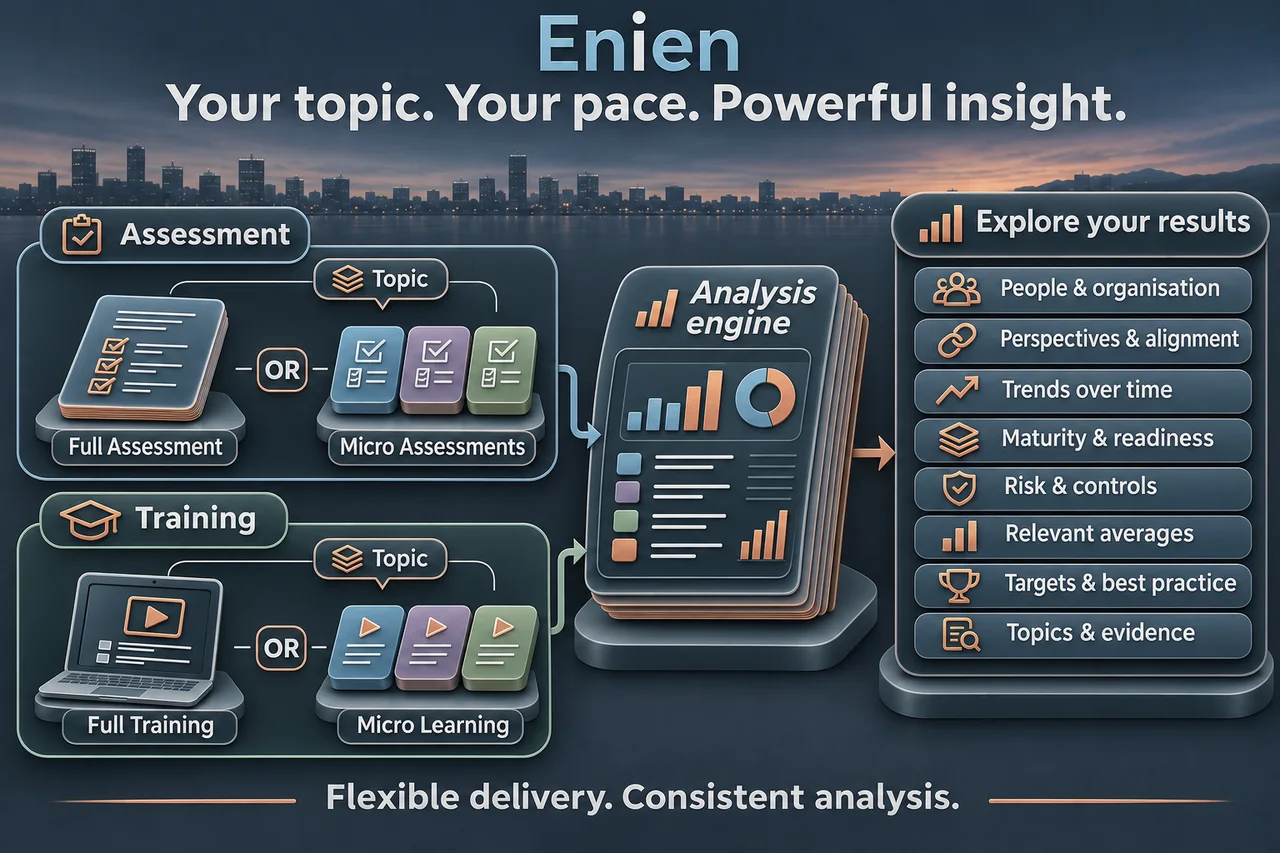
Bring assessment responses and supporting evidence together to understand differences and focus your next step. Choose full assessments or Micro Assessments, full training or Micro Learning to suit the topic and the people taking part.
01
Work through the full assessment or training in one go, or take it topic by topic. Choose the scope around your business need and the delivery around your people.
Complete the topic in one go, or answer coherent groups of questions a topic at a time. Both routes complete the same underlying assessment.
Complete the training in one go, or build understanding through smaller, focused learning sessions.
02
Use the same platform for different audiences and practical ways of taking part.
People sign in to their customer workspace and complete the assessments assigned to them.
A campaign link can take participants into an assessment without a customer login, according to the campaign setup.
Send topic-based Micro Assessments and focused Micro Learning sessions over time, according to the programme schedule.
03
Run a complete training programme in one go or deliver short, focused Micro Learning sessions. Pair learning with full assessments or Micro Assessments to explore understanding and application.
Learning outcomes and assessment responses remain distinct within the programme.
04
The Enien engine offers connected ways to explore the results. These examples show how you can move from an overall view to the areas, questions and evidence that need attention.
Compare relevant results across individuals, teams, divisions and geographies to see where the picture differs.
Compare leadership, user, policy and expert views. Add the external lens through PentaView where relevant.
Compare compatible completed assessments at different dates to see how results change.
Understand current capability and readiness using the relevant assessment hierarchy and maturity descriptions.
Explore risk positions and, for compatible assessments, compare inherent and residual risk.
Put assessment results alongside relevant averages, refined as comparable assessment results accumulate.
Use applicable best-practice references and contextual targets to discuss where improvement is appropriate.
Drill from the overall picture into topics, framework sections, individual questions and the supporting responses or evidence.
Available views depend on the assessment type, scope and recorded evidence. Trends use compatible completed assessments. Observed averages, organisational targets and best-practice references remain distinct.
05
Use the findings to decide what deserves attention and what to do next. A clearer understanding or confirmation of the current approach can be as useful as identifying a change. Examples include:
Be ready to use what you learn. Choose actions in the context of your organisation and the evidence behind the findings.
06
Use the overall picture, selected comparisons and supporting detail to discuss strengths, gaps and where to focus next. Share the relevant findings through assessment reports and PDF output.
07
Customers are using AI to explore solutions and compare providers. Test whether your business appears for relevant buyer needs, how your services are described and which alternatives are mentioned. Use External Assessment independently or connect the external evidence through PentaView.
08
Defined scope, quality checks and retained evidence give AI responses a clear assessment context.
Evidence and review status support judgement. Consider AI responses against the relevant facts and context.
09
We are developing follow-up research for a particular service or competitive position, with separately agreed scope and deliverables.
In development
Participants can use their account or a secure invitation or campaign link, depending on the programme setup. Email delivery needs an email address. Anonymous campaigns use their own participation settings.
Yes. Complete the same assessment in one go or topic by topic through Micro Assessments. The original questions and saved responses feed the same Enien analysis and reporting once the required assessment scope is complete.
Yes. Scope content around the topics, question groups or sections of a framework that matter to your organisation.
Learning and assessment have different purposes. Learning helps people understand a topic; assessment responses provide the input to the assessment result. Keep the two clear when designing a programme.
It records which companies are mentioned or recommended in answers to the assessed buyer questions and compares the service context. This shows the observed alternatives for those questions; it is not a market-share ranking.
Where leaders supply the services, priorities and outcomes they want external messaging to support, those inputs can be compared with the website’s published emphasis and the observed AI picture.
Findings and comparisons are supported by relevant evidence references and coverage information, helping you understand the result and its limits. Agree any additional research, data access or export requirements when defining the engagement.
We are developing follow-up competitor and service-market research. The proposed scope includes provider propositions, claimed differentiators and a company-centred market view, with evidence and estimates clearly distinguished.
Enien works within a defined assessment scope, uses question-quality checks and recorded reviews, and retains the responses and evidence behind the findings. Coverage, proposed service matches and interpretation status stay visible. The process helps you inspect and challenge AI output; it does not guarantee every answer is correct.
Micro Assessments deliver an assessment in small, coherent groups of questions, such as one topic at a time. Micro Learning delivers training in short, focused learning sessions. You can also complete the assessment or training in one go.
Enien supports comparisons across people and organisational groups, differences between perspectives, trends over time, and maturity, readiness and risk views. Relevant averages, contextual targets and best-practice references help put results in context. Drill into topics, questions and supporting responses or evidence, and communicate findings through reports. Available views depend on the assessment type, scope and recorded evidence.
Yes. Compare compatible completed assessments from different dates to see how results change. Comparable question coverage and the assessment dates matter: a change in scope or population should be considered when interpreting the trend.
Useful outcomes include a shared understanding, further investigation, a decision to keep the current approach or a targeted change. Examples include focusing learning, reviewing a policy or control, prioritising resources and checking progress. Use the relevant evidence and business context to choose the next step.
Tell us the problem, the people involved and where you would like to start.
Already a customer? Sign in to your workspace.