Policy adoption
What do people understand and report doing?

For boards and oversight
Support board discussion with a clearer view of how people understand requirements, how they experience them and where attention is needed.
01
Explore how expectations are understood and applied across the organisation.
What do people understand and report doing?
Where do leaders, users, policy owners and experts see different pictures?
What has been covered, what remains uncertain and what needs attention?
02
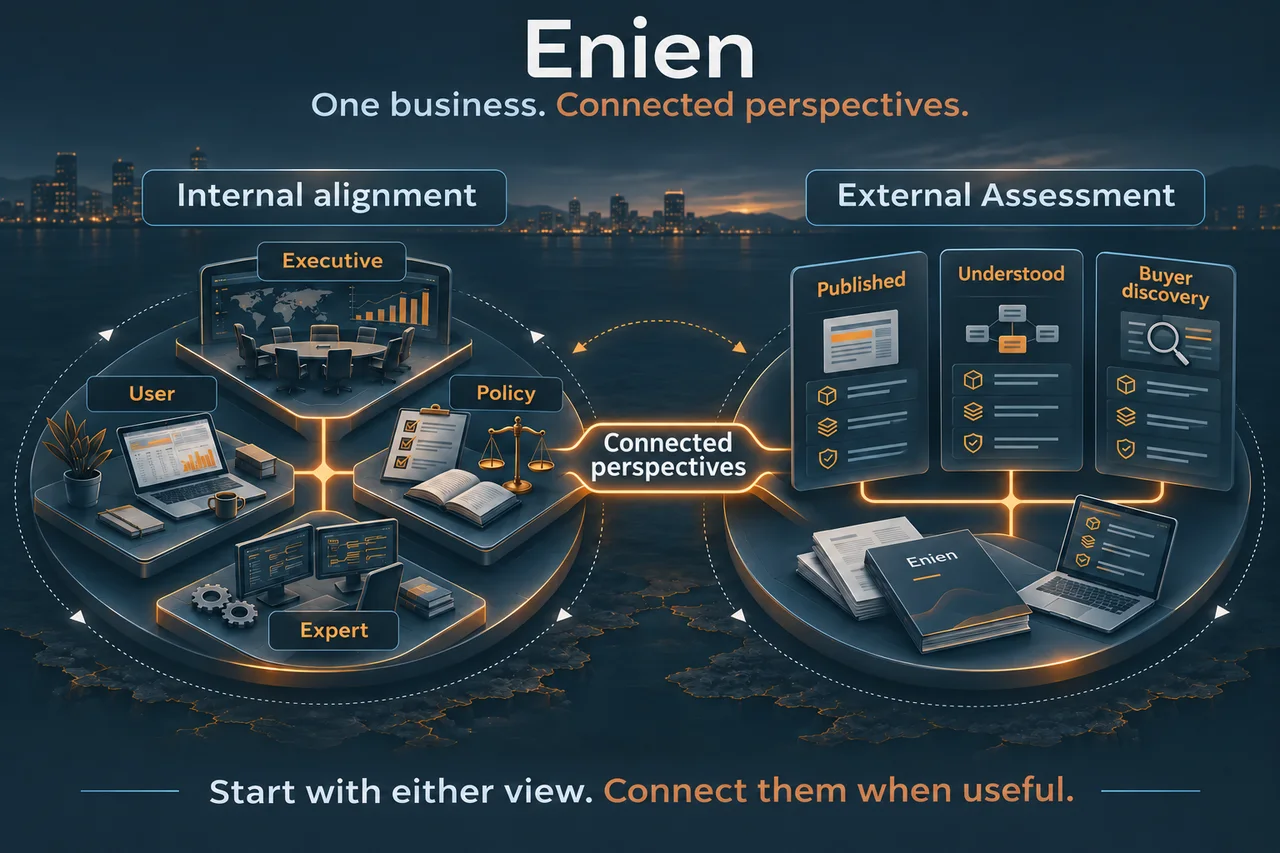
Bring executive, user, policy owner and expert views together around the same requirement. Use important differences to focus investigation and discussion.
03
AI-assisted buying gives the board a reason to check whether the external message supports the strategy. External Assessment records how AI describes the company, which services it associates with the business and which providers appear for relevant buyer needs. Compare these observations with supplied leadership priorities.
04
People can complete the work in one go or through Micro Assessments and Micro Learning. Compare relevant groups and perspectives, track compatible assessments over time and inspect the questions and evidence behind the findings.
Available views depend on the assessment type, scope and recorded evidence. Trends use compatible completed assessments. Observed averages, organisational targets and best-practice references remain distinct.
05
Use the responses, context and relevant evidence to decide where the board needs a clearer explanation, further assurance or an agreed follow-up. Findings can inform priorities and resource discussions, as well as a decision to continue the current approach.
Enien provides structured views and assessment information to support oversight. Boards use it alongside their existing assurance, governance and specialist advice.
It compares executive, user, policy owner and expert responses on the same requirement, helping boards explore where confidence and experience differ.
Enien supports comparisons across people and organisational groups, differences between perspectives, trends over time, and maturity, readiness and risk views. Relevant averages, contextual targets and best-practice references help put results in context. Drill into topics, questions and supporting responses or evidence, and communicate findings through reports. Available views depend on the assessment type, scope and recorded evidence.
Yes. Compare compatible completed assessments from different dates to see how results change. Comparable question coverage and the assessment dates matter: a change in scope or population should be considered when interpreting the trend.
Useful outcomes include a shared understanding, further investigation, a decision to keep the current approach or a targeted change. Examples include focusing learning, reviewing a policy or control, prioritising resources and checking progress. Use the relevant evidence and business context to choose the next step.
Tell us the problem, the people involved and where you would like to start.
Already a customer? Sign in to your workspace.