Executives
The leadership view of priorities, confidence and oversight.

Compare perspectives with QuadraView
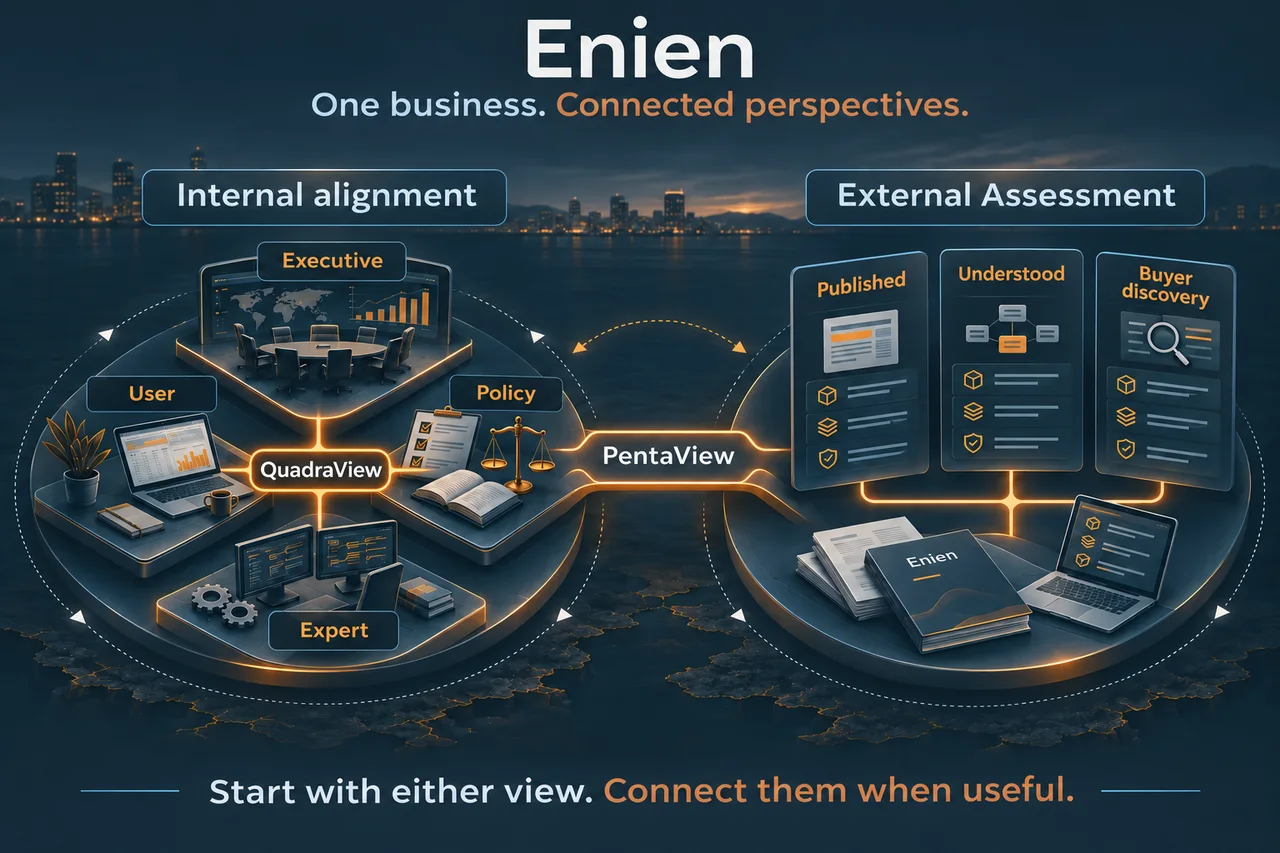
QuadraView compares executive, user, policy owner and expert perspectives. PentaView adds an external lens, helping you connect internal alignment with how your organisation is seen outside.
01
Each group sees a different part of the organisation. Compare their responses against the same requirement.
The leadership view of priorities, confidence and oversight.
The experience of people applying requirements in their work.
The people defining expectations, responsibilities and policy.
The specialist view of the requirement and its context.
02
A gap between perspectives is a reason to investigate. It can point to unclear expectations, different experiences or evidence that needs closer attention.
Are requirements being interpreted in the way intended?
Does leadership confidence match the experience reported by teams?
Where would clearer guidance, learning or follow-up help?
03
QuadraView helps you understand internal alignment. PentaView adds External Assessment alongside those four perspectives, so you can examine where internal views and the external picture agree or differ.
Start with what leaders, users, policy owners and experts say. Add external observations to explore how that picture is reflected outside.
Use External Assessment independently when you first need to understand how AI describes your company, services and competitive alternatives.
04
When buyers use AI to find solutions, your intended positioning and the answers they encounter may differ. Compare supplied leadership priorities with the website, AI descriptions and whether your company appears for relevant buyer needs.
Use supplied leadership priorities to explore whether the published and AI-observed service picture reflects the intended emphasis.
Discuss whether the observed picture supports the intended business role: attracting opportunities, building credibility or supporting relationships.
Examine the competitors and suppliers returned in the assessed answers, keeping mentions separate from recommendations.
Leadership intent comes from supplied leader input. External findings retain their own questions, provider context and evidence; they are considered alongside internal views.
05
Use full assessments or Micro Assessments, full training or Micro Learning around the topic that matters. Compare internal perspectives as well as people and organisational groups; track changes across compatible completed assessments; and explore relevant maturity, readiness, risk and reference views. Follow the differences into the supporting questions and evidence.
06
Use the recorded responses, evidence and covered scope to support discussion and decisions. Follow up on important differences before drawing conclusions about their causes.
QuadraView is Enien’s approach to comparing four internal perspectives: executives, users, policy owners and subject matter experts.
They highlight areas for investigation and discussion. A difference alone does not establish its cause; responses, evidence and context help you explore it.
Choose the scope around your business question, then complete the assessment in one go or topic by topic through Micro Assessments. Both routes use the same Enien analysis when the required assessment coverage is complete.
QuadraView compares executive, user, policy owner and subject matter expert perspectives. PentaView adds an external perspective through External Assessment. The internal perspectives and external observations retain their own evidence.
No. External Assessment can be used independently to examine the published service picture, AI understanding, buyer discovery and observed competitors. It can also extend internal alignment work.
Enien supports comparisons across people and organisational groups, differences between perspectives, trends over time, and maturity, readiness and risk views. Relevant averages, contextual targets and best-practice references help put results in context. Drill into topics, questions and supporting responses or evidence, and communicate findings through reports. Available views depend on the assessment type, scope and recorded evidence.
Yes. Compare compatible completed assessments from different dates to see how results change. Comparable question coverage and the assessment dates matter: a change in scope or population should be considered when interpreting the trend.
Useful outcomes include a shared understanding, further investigation, a decision to keep the current approach or a targeted change. Examples include focusing learning, reviewing a policy or control, prioritising resources and checking progress. Use the relevant evidence and business context to choose the next step.
Tell us the problem, the people involved and where you would like to start.
Already a customer? Sign in to your workspace.